Car Colour Protection: Because Your Vehicle Deserves a Better Sunscreen Than You
Why Car Colour Protection Is the Smartest Investment You'll Make for Your Vehicle
Car colour protection is the practice of applying a physical or chemical barrier to your vehicle's painted surfaces to defend against UV rays, road debris, chemical stains, and everyday wear that slowly degrade your paint's appearance and value.
Here's a quick look at your main options:
Protection MethodBest ForLifespanDIY Friendly?Paint Protection Film (PPF)Physical impact, chips, scratches10+ yearsNo
Ceramic CoatingUV, chemical resistance, gloss2–5 yearsLimited
Vinyl WrapColour change, style5–7 yearsNo
Traditional WaxBasic shine, light protection1–3 monthsYes
Your car's paint faces a daily assault. UV rays cause oxidation and fading. Road debris chips and scratches the clear coat. Bird droppings, bug acids, and road salt eat into the finish if left untreated. And once that damage sets in, it's expensive to reverse.
The good news? Modern protection solutions — especially paint protection film — have come a long way. What started as military-grade "helicopter tape" used to protect rotor blades during the Vietnam War is now a precision-engineered, self-healing film trusted by everyday drivers and exotic car owners alike.
At The Vinyl Frontier, we've built our reputation on high-quality vehicle wraps and custom graphics, and car colour protection is a natural extension of that expertise — helping vehicle owners keep their investment looking sharp for years to come.
What is Paint Protection Film (PPF)?
When we talk about the heavy hitter in car colour protection, we are talking about Paint Protection Film, or PPF. You might have heard it called a "clear bra," but it’s essentially a transparent, ultra-durable thermoplastic urethane film. Think of it as a secondary skin for your car that’s designed to take the punches so your factory paint doesn't have to.The history of PPF is actually quite fascinating. It wasn't originally designed for a Sunday drive through Hanceville. It was developed by 3M during the Vietnam War to protect helicopter rotor blades from shrapnel and flying debris. If it can keep a helicopter flying in a war zone, you can bet it can handle the gravel kicked up by a tractor on an Alabama backroad.
Modern PPF is a marvel of engineering. It’s composed of several layers, including a clear coat that features self-healing technology. This means that if the film gets a light scratch or swirl mark, the application of heat—whether from the Alabama sun or a splash of warm water—causes the molecules to rearrange themselves, making the scratch disappear. It’s not magic; it’s just very clever chemistry.
For a deeper dive into the mechanics of this material, check out The Ultimate Guide to Paint Protection Film.
The Science of Car Colour Protection
To understand why you need car colour protection, we have to look at what happens to your paint at a microscopic level. Your car's finish is composed of a primer, a base coat (the colour), and a clear coat. That clear coat is what gives the car its shine, but it’s also the frontline of defense.In the heat of May 2026, the sun is your paint's biggest enemy. UV radiation triggers a process called oxidation, which breaks down the chemical bonds in the paint, leading to a dull, chalky appearance. Beyond the sun, environmental contaminants like bird droppings and bug splatter are highly acidic. If left on the surface, they can "etch" into the clear coat in a matter of hours, leaving permanent scars.
Here is how the top protection methods stack up against these threats:
FeatureTraditional WaxCeramic CoatingPaint Protection Film (PPF)Rock Chip DefenseZeroMinimalExcellent
UV ResistanceLowHighHigh
Self-HealingNoNoYes
Hydrophobic (Water Repelling)ModerateExcellentHigh (with topcoat)
Chemical ResistanceLowHighHigh
While products like 3M™ Paint Protection Film Series 150 provide a physical barrier against rocks and keys, they also offer incredible chemical resistance. This prevents road salt and industrial fallout from ever reaching the actual paint.
If you want to keep that "just off the lot" glow, you need to understand the relationship between these layers. For more on preserving that aesthetic, see our guide on how to Guard Your Gloss: The Ultimate Guide to Car Color Protection.
Choosing Your Level of Car Colour Protection
Not every driver needs a full-body suit of armor, which is why we offer tiered packages to fit different needs and budgets. The goal of car colour protection is to address the areas most likely to see damage.Partial Front Package: This covers the high-impact zones—the front bumper, the leading edge of the hood, and the side mirrors. This is the "essential" package for those who do a lot of highway driving.
Full Front Package: This extends protection to the entire hood and front fenders. This eliminates "seam lines" on the hood, providing a completely invisible look.
Track Pack / Highway Pack: This adds protection to the rocker panels (the bottom sides of the car) and the rear wheel arches. These areas are constantly peppered by debris kicked up by your own tires.
Full Body Coverage: The ultimate peace of mind. Every painted surface is wrapped. This is popular for luxury vehicles, exotics, or anyone who wants their daily driver to stay in mint condition for a decade.
Don't forget the headlights! Modern plastic headlights are prone to oxidation, which causes that ugly yellowing and reduces visibility. Applying a small piece of PPF can prevent this entirely. For more on specific coverage strategies, read The Ultimate Clear Bra Installation Guide: Protect Your Assets.
Professional Installation vs. DIY: Why Precision Matters
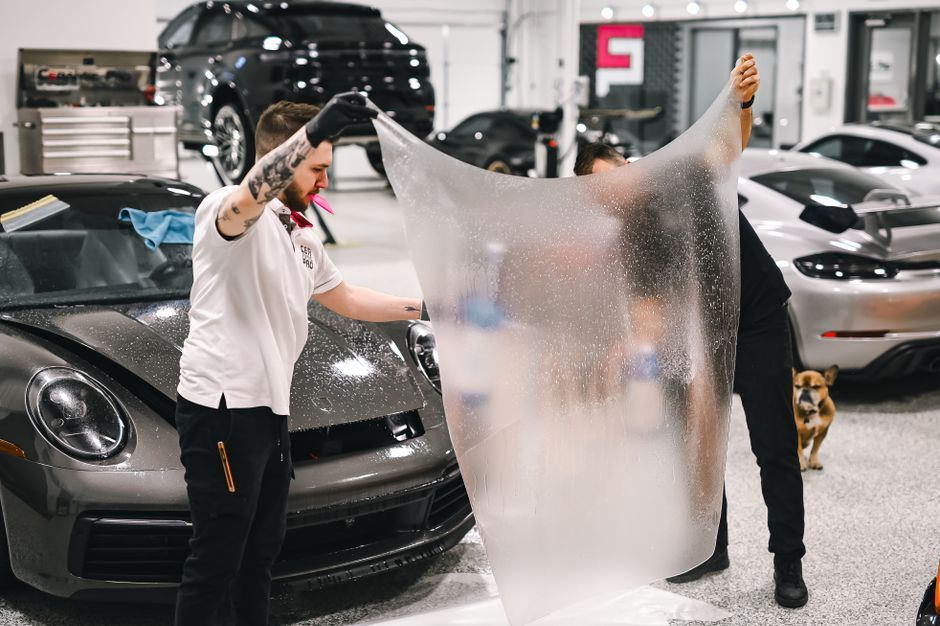
We get it—the "Do It Yourself" spirit is strong in Alabama. But when it comes to car colour protection, the gap between a pro job and a DIY attempt is massive. Installing PPF is nothing like putting a screen protector on your phone; it’s more like performing surgery on your car’s exterior.At The Vinyl Frontier, our professional installation process involves several critical steps that you simply can't replicate in a home garage:
- Decontamination: Even a brand-new car has contaminants. We use clay bars and iron removal chemicals to ensure the surface is surgically clean. If you trap a single speck of dust under the film, it will look like a permanent pimple on your car.
- Paint Correction: If your paint has existing swirls or scratches, the film will actually magnify them. We often perform a light polish to ensure the paint is perfect before it’s "locked in" by the film.
- Precision Plotting: We use high-end computer software and plotters to cut the film into exact patterns for your specific make and model. This ensures perfect fitment around sensors, emblems, and door handles without us ever having to take a blade to your car's surface.
- Edge Wrapping: Wherever possible, we wrap the edges of the film around the panels. This makes the installation virtually invisible and prevents the edges from lifting over time.
- Controlled Environment: Dust is the enemy. Our facility in Hanceville is kept clean and temperature-controlled to ensure the adhesive cures correctly.
DIY kits often lead to "silvering" (bubbles), stretch marks in the film, and misaligned edges. When you consider that full-car PPF coverage can cost between $4,000 and $7,000 CAD (or the equivalent in USD), you don't want to risk wasting that material.
To see why professional prep is the secret sauce, check out Beyond the Wash: Ultimate Guide to Automotive Paint Protection.
Maintaining Your Shield for the Long Haul
Once your car colour protection is installed, you can’t just forget about it—though it does make your life a whole lot easier.The first 48 hours to a week are the "curing window." During this time, the moisture used during installation is evaporating. You might see tiny bubbles or a slight haziness; don't panic! This is normal. However, you must avoid washing the car or exposing it to high-pressure water during this time.
Once cured, maintenance is a breeze:
- Wash Regularly: Use a pH-neutral shampoo and the two-bucket method.
- Avoid Automatic Brushes: Those "spinning slap-brushes" at the local gas station are filled with dirt from the truck that went through before you. They can mar even the best film. Stick to touchless washes or hand washing.
- Use a Topcoat: While not required, applying a product like Armor All® Ultra Shield Ceramic Spray Coating on top of your PPF can enhance its hydrophobic properties, making dirt and water slide right off.
- Heat is Your Friend: If you notice light swirls, leave the car in the sun. The self-healing top layer will do the work for you.