Don't Get Stretched Thin Understanding the Silkscreen Process
What "Silkscreen" Really Means (And Why It Still Matters)
Silkscreen is a printing method that pushes ink through a mesh stencil onto a surface — whether that's a t-shirt, a poster, a sign, or even a ceramic tile.
Silkscreen printing is one of the oldest and most versatile printing methods in the world. It originated in China during the Song Dynasty (960–1279 AD) and has since evolved from hand-pulled art prints to automated presses running up to 6,000 impressions per hour.
Today, it accounts for more than half of all garment printing activity in the United States — and it's used far beyond clothing, from business signage to printed electronics.
But with so many printing options available — DTG, HTV, digital — it can be hard to know which method is right for your project.
At The Vinyl Frontier, we've built our reputation on helping local businesses make a real visual impact through high-quality custom graphics, signage, and wraps — and understanding processes like silkscreen is central to what we do. Whether you're new to custom printing or looking to sharpen your knowledge, this guide will walk you through everything you need to know.
What is Silkscreen Printing?
At its heart, silkscreen printing—also known as screen printing or serigraphy—is a porous printing technique. Unlike offset printing which uses plates or digital printing which sprays tiny droplets of ink, silkscreen relies on a physical stencil attached to a fine mesh fabric.According to Britannica, the process involves forcing a thick paste-like ink through the open areas of the mesh onto a substrate. Any area of the screen that shouldn't receive ink is blocked off by a stencil. This allows for incredibly vibrant, thick layers of ink that sit on top of the material rather than soaking in, creating a tactile and durable finish.
The beauty of this method lies in its substrate versatility. While we often think of t-shirts first, PrintWiki notes that it can be used on almost any surface, including:
- Textiles (cotton, polyester, silk)
- Paper and cardboard (posters and packaging)
- Wood and metal (signs and crates)
- Glass and ceramics (bottles and mugs)
- Plastics and electronics (circuit boards)
In the industrial world, this process is used for mass production, while in the art world, it is often called serigraphy to distinguish it as a fine art medium. Whether it's a DIY project in a garage or a high-speed cylinder press, the fundamental mechanics remain the same.
The Evolution and History of the Process
The history of silkscreen is a journey from ancient craftsmanship to modern industrial power. It began in China during the Song Dynasty (960–1279 AD) as a refinement of basic stenciling. Early versions used human hair stretched across frames to hold intricate stencils in place.The technique eventually migrated to Japan, where artisans developed "Ise-katagami," using silk thread to bridge gaps in paper stencils. However, it wasn't until the late 1800s that the process gained traction in Europe. In 1907, Samuel Simon of Manchester, England, was granted a patent for using silk fabric as a printing screen.
The 20th century saw a massive boom in the technology. In the 1910s, photo-imaged stencils were developed, allowing for much finer detail. During the Great Depression, the WPA (Works Progress Administration) in the United States employed artists who used the method to create vibrant posters. This is when the term "serigraphy" was coined to help the public view the process as a legitimate art form rather than just a commercial tool.
By the 1960s, silkscreen became a cultural icon. Artists like Andy Warhol used it to create legendary Pop Art pieces, such as the Marilyn Diptych. Simultaneously, the invention of the rotatable multi-color garment press sparked the modern t-shirt boom. Today, the process is so advanced that modern cylinder presses can produce between 4,000 and 6,000 impressions per hour.
A Step-by-Step Guide to the Printing Process
Creating a high-quality silkscreen print is a meticulous process that requires precision at every stage. Here is how we break down the workflow:Artwork Preparation: Everything starts with a design. For the best results, artwork should be in a vector format (like .AI or .EPS). This ensures lines stay crisp and colors can be easily separated.
Screen Preparation: A mesh screen—usually made of polyester—is stretched tightly over a frame. Tension is critical; polyester is typically stretched to 1–4% of its original dimensions to ensure the ink passes through evenly.
Emulsion Coating: The screen is coated with a light-sensitive liquid called photo emulsion and left to dry in a dark room.
UV Exposure (The "Burn"): The design is printed onto a transparent film positive. This film is placed on the emulsion-coated screen and exposed to UV light (usually in the 350–420 nanometer spectrum). The light hardens the emulsion everywhere except where the design blocks it.
Washing Out: The screen is sprayed with water. The unhardened emulsion (the part blocked by the design) washes away, leaving a perfect stencil in the mesh.
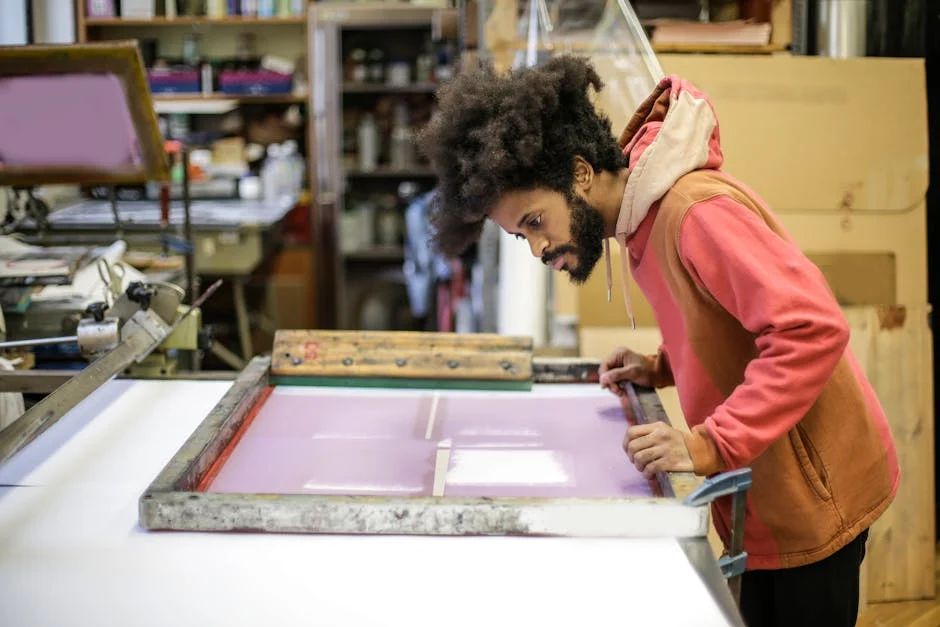
The Print Stroke: The screen is placed over the substrate. Ink is placed at the top, and a "flood bar" fills the mesh with ink. Then, using a squeegee, the printer pulls the ink across the screen with consistent pressure and angle, forcing it through the open stencil onto the material.
Curing: To make the print permanent, it must be cured with heat. For example, plastisol inks usually require temperatures around 150°C (300°F) to chemically bond to the fabric.
Essential Materials for a Quality Silkscreen
To get professional results, you can't cut corners on materials. At The Vinyl Frontier, we know that quality starts with the right tools. If you are looking for high-end results for your business, you can explore Our Services to see how we apply these standards to our custom work.- Mesh: While it was once made of silk, modern screens use polyester. Mesh count matters: a lower count (like 110) is great for bold graphics on dark shirts, while a higher count (230+) is needed for fine details.
- Frames: Aluminum frames are preferred over wood because they don't warp and maintain better tension over time.
- Squeegees: These come in different "durometers" (hardness levels). A softer squeegee deposits more ink, while a harder one is better for fine lines.
-
Inks:
- Plastisol: The industry standard. It's thick, opaque, and sits on top of the fabric.
- Water-based: Thinner and soaks into the fibers for a "soft-hand" feel.
- Specialty: Puff inks, glitters, and metallic foils can add unique textures.
Different Types of Silkscreen Stencils
The stencil is the "brain" of the silkscreen process. There are several ways to create one:- Photo-Emulsion: The most common professional method using UV light as described above. It allows for the highest level of detail.
- Hand-Cut Stencils: Often used in DIY or artistic settings, where shapes are cut out of film or paper by hand.
- Blockout Solution: For simple designs, a liquid blockout can be painted directly onto the screen to stop ink flow.
- Film Positives: These are the transparent sheets used during exposure. High-density black ink on the film is required to block UV light effectively.
If you're interested in how different stenciling and adhesive methods work for smaller applications, check out The Ultimate Guide to Finding Speedy Sticker Printing Services.
Comparing Silkscreen to DTG and HTV Methods
When you're deciding how to brand your business or event, you'll likely run into three main contenders:Silkscreen, Direct-to-Garment (DTG), and Heat Transfer Vinyl (HTV).
FeatureSilkscreenDTG (Digital)HTV (Vinyl)Best Volume50+ items1–10 itemsSmall batches/Names
DurabilityExtremely HighModerateHigh (if applied correctly)
Color VibrancyBest on Dark FabricsBest on Light FabricsSolid Colors
Setup CostHigh (Per Screen)LowLow
FeelTactile/RaisedSoft/No FeelPlastic-like
Silkscreen is the undisputed king of volume. Because of the setup time involved in "burning" screens, most shops have a minimum order quantity of 25 to 50 pieces. However, once the screens are ready, the per-unit cost drops significantly.
DTG is like a giant inkjet printer for shirts. It's great for one-off photos but doesn't have the same "pop" on dark fabrics that silkscreen provides. HTV involves cutting designs out of vinyl sheets and pressing them on. It's perfect for individual names or numbers on jerseys but isn't cost-effective for large logos.
For more on how to choose the right branding method for your business, see our guide: Make Your Mark: Everything You Need to Know About Business Logo Decals.
Specialized Applications: From Polymer Clay to Industrial Signs
While we often focus on shirts, the silkscreen process is incredibly adaptable. One fascinating niche is crafting with polymer clay. Artists use specialized, fine-mesh screens (like those from Moiko) to apply intricate patterns to raw clay.The process is simple: Place the screen on the clay. Apply a line of heavy-body acrylic paint. Squeegee the paint across the stencil. Peel and bake the clay.
In the industrial sector, silkscreen is used for vehicle wraps and heavy-duty signage.
At The Vinyl Frontier, we specialize in creating durable signs that stand up to the Alabama sun. Whether you need a 16-foot-wide roadside billboard or custom decals, the principles of ink durability and stencil precision are what make these products last.
For those looking to brand their outdoor spaces or storefronts, you might find our article on Sun, Sand, and Stickers: Your Guide to Beach Window Decals helpful for understanding how different materials handle the elements.
Frequently Asked Questions about Silkscreening
How do I get started with silkscreen printing at home?
Getting started at home is easier than ever. You can purchase beginner kits that include a wooden frame, a basic squeegee, and water-based inks (which are easier to clean than plastisol). For stencils, you can start with the "drawing fluid" method or use a simple sun-exposure technique with transparency film if you don't have a professional light box.What are the main advantages and disadvantages of this method?
Advantages:- Bulk Savings: The more you print, the cheaper it gets.
- Durability: Professionally cured prints can outlast the garment itself.
- Vibrancy: Thick ink layers look amazing on dark substrates.
Disadvantages:
- Setup Time: It takes time to prep screens for each color.
- Limited Detail: While it can do great detail, it can't match the photographic resolution of digital printing for very small runs.
- Color Limits: Each color requires a separate screen, which can get expensive for designs with 10+ colors.