The Complete Guide to Channel Letters
What Channel Letters Can Do for Your Business Visibility
Channel letters are three-dimensional, individually crafted signs that spell out your business name or logo on the face of a building. They're one of the most recognized and effective forms of commercial signage — and for good reason.
Here's a quick summary of what you need to know:
- What they are: Custom 3D letters made from aluminum and acrylic, typically 2–6 inches deep
- How they're lit: Front-lit, back-lit (halo), combination, or non-illuminated
- Where they're used: Storefronts, malls, restaurants, hotels, hospitals, and more
- Why businesses use them: High visibility day and night, strong brand presence, long lifespan
- Key material: Rust-resistant aluminum body with translucent acrylic face and LED lighting inside
If your storefront isn't getting noticed, a flat sign probably isn't helping. Channel letters stand out literally — their depth and illumination make them visible from a distance, day or night, in a way that flat signage simply can't match.
They were first introduced in the early 1970s and have been a staple of commercial signage ever since. Today, LED technology has made them more energy-efficient, thinner, and more customizable than ever before.
At The Vinyl Frontier, we bring years of hands-on experience in custom signage — including channel letters — to businesses that want to make a real impression. If you're ready to upgrade your brand visibility, you're in the right place.
What are Channel Letters and How are They Fabricated?
To the average passerby in Hanceville or Dodge City, channel letters just look like bright, professional signs. But behind that glow is a sophisticated engineering process. A standard channel letter is a three-dimensional graphic sign element. Unlike a flat "printed" sign, each letter is an individual "can" or enclosure.The fabrication process begins with a vector-based art file. This digital blueprint tells our machines exactly where to cut. We typically use sheet aluminum for the back and sides because it’s the superhero of the sign world—it won’t rust, it’s lightweight, and it’s incredibly durable against the Alabama weather.
To get those perfect curves and sharp angles, the aluminum is cut using a computer-controlled router, laser, or water jet. If you want to dive deeper into the technical side of how these signs have evolved over the decades, you can explore Scientific research on channel letter technology.
Once the back is cut, we move on to the "returns"—the sides of the letter that give it depth. These are formed by bending aluminum strips to match the shape of the back. In the past, these were often 5–6 inches deep, but thanks to modern, slim LED technology, we’re seeing a trend toward shallower profiles of just 2–3 inches. This creates a sleeker, more modern look for your storefront.
For more information on the variety of options we offer, check out our page on custom signs, wraps, banners, decals, and shirts in Hanceville, AL.
The Anatomy of Channel Letters
To understand why channel letters are so durable, you have to look at what’s inside the "can." Here are the five main components:The Back: This is the foundation, usually cut from a flat sheet of aluminum. It provides the structural integrity and the mounting surface for the internal lighting.
The Returns: This is the strip of aluminum that forms the sides of the letter. It’s what creates the "channel" (hence the name). We often paint the inside of these returns white to help reflect and maximize the light output.
The Lighting: Historically, neon was the king of the castle. Today, energy-efficient LED modules are the gold standard. They are smaller, last longer (up to 100,000 hours!), and are much cheaper to run.
The Face: For most signs, this is a 3/16-inch thick piece of translucent acrylic or polycarbonate. This is where the color comes from. We can use colored acrylic or apply specialized vinyl to achieve the exact brand color you need.
The trim cap: This is a plastic or metal border that attaches the face to the returns. It’s a small detail, but it’s what keeps the face secure and gives the letter a finished, professional look.
Choosing the Right Illumination and Design
Choosing the right look for your channel letters is about more than just picking a pretty color. It’s about visibility, brand identity, and even psychology. Do you want to look high-end and subtle? Or do you want to be the brightest beacon on the block?Design flexibility is one of the biggest benefits of channel letters. You aren't limited to a few standard fonts. Because we use precision cutting tools, we can replicate your specific logo and brand font with incredible accuracy.
When designing, we also think about color psychology. Red can imply urgency or excitement (great for restaurants), while blue often suggests trust and professionalism. If you're interested in how different materials can affect your brand's "vibe," you might enjoy our guide on how to shine on with metal signs.
Illumination Styles for Channel Letters
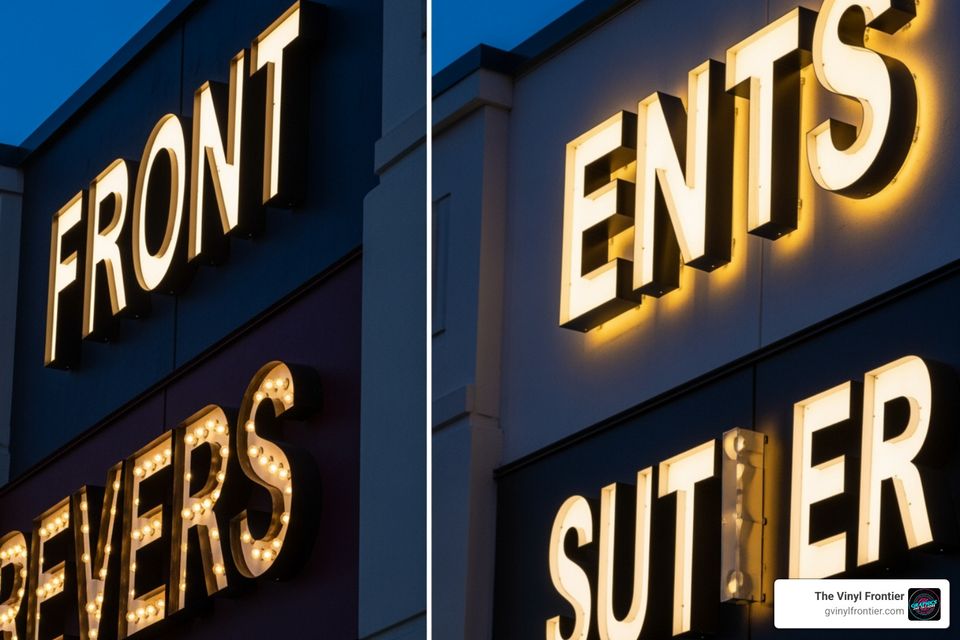
There are several ways to light up your brand, each offering a different aesthetic:- Front-Lit (Face-Lit): This is the most common style. Light shines through the acrylic face, making the letters bright and easy to read from a long distance.
- Back-Lit (Halo-Lit / Reverse): Instead of a translucent face, these have an aluminum face and a clear or open back. The letters are mounted slightly away from the wall using spacers, creating a sophisticated "halo" effect on the building surface. This is a favorite for upscale boutiques and professional offices. For the best effect, a light-colored, matte wall surface works best to reflect the light.
- Combination-Lit: Why choose one when you can have both? These letters shine through the front and create a halo on the back, often using different colors for a striking contrast.
- Open Face: These have a vintage, retro feel. The face is either clear or non-existent, letting the light source (often LED tubes designed to look like neon) be seen directly.
- Infinity Mirror: A modern innovation that uses mirrors and LEDs to create an "infinite dimension" effect inside the letter. It’s a real head-turner for bars and entertainment venues.
- Day/Night Vinyl: This is a cool trick! We use perforated vinyl that appears black during the day but glows white when the LEDs are turned on at night.
Even if you are in a specialized industry, like construction, signage matters. We've put together a resource on signage for home builders that highlights how effective branding works in the field.
Mounting Options and Installation Best Practices
How your channel letters are attached to your building is just as important as how they look. There are three main ways we handle installation in Hanceville and Dodge City:Flush Mount (Direct Mount): Each letter is mounted directly to the building facade. The power cables are fed through small holes in the wall and connected behind the scenes. This is the cleanest, most "custom" look, but it requires more holes in your building (usually 3–5 per letter).
Raceway Mount: A raceway is a rectangular metal box that houses all the electrical wiring and power supplies. The letters are mounted to the raceway, and then the raceway is mounted to the building. Landlords often prefer this because it requires far fewer holes in the facade. We can even paint the raceway to match your building's color so it blends right in.
Wireway Mount: This is similar to a raceway but much thinner. It’s used when a landlord requires a mounting structure but you want something less bulky than a traditional raceway.
Pin Mount: Specifically used for back-lit or halo-lit signs. The letters are "pinned" away from the wall (usually about 1.5 inches) to allow the light to spread out and create that beautiful glow.
When choosing a mounting style, always check your local Hanceville or Dodge City zoning laws and your lease agreement. Many shopping centers have strict "landlord requirements" regarding how signs can be attached. If you're feeling stuck on the design or placement, we have some great sign design ideas to unlock your creativity.
Frequently Asked Questions about Signage
How long do LED channel letters typically last?
One of the biggest advantages of modern channel letters is their longevity. The LED modules we use are rated for up to 100,000 hours. To put that in perspective, if you leave your sign on for 12 hours every night, those LEDs could last for over 20 years!Unlike old-fashioned neon, which could be fragile and leak gas, LEDs are solid-state electronics. They handle the Alabama heat and humidity much better and require very little maintenance. Usually, a quick cleaning of the acrylic face once or twice a year is all you need to keep it looking brand new.
What factors influence the total cost of channel letter signs?
Every sign we build at The Vinyl Frontier is custom, so prices vary. The main factors that will influence your quote include:- Size: Larger letters require more aluminum, more acrylic, and more LEDs.
- Complexity: A standard block font is easier (and cheaper) to fabricate than a complex, script-style logo with many tight curves.
- Illumination Type: Front-lit signs are generally the most budget-friendly, while combination-lit or infinity mirror signs require more labor and components.
- Mounting Method: A raceway mount can sometimes save you money on installation labor compared to a flush mount, which requires more time to wire through the wall.
Can channel letters be used for indoor applications?
Absolutely! While they are famous for storefronts, channel letters are becoming a huge trend for interior branding. You’ll often see them in:- Lobbies and Receptions: A halo-lit logo behind a reception desk looks incredibly professional.
- Department Stores: Used for "wayfinding" to mark different sections (like "Shoes" or "Menswear").
- Restaurants and Bars: Creating a specific "vibe" or photo-op spot for customers to share on social media.
Indoor channel letters are often shallower (the 2–3 inch depth) since they don't need to be seen from a highway, making them perfect for close-up viewing.