A Classy Touch for Your Desk or Door
The Timeless Appeal of a Brass Name Plaque
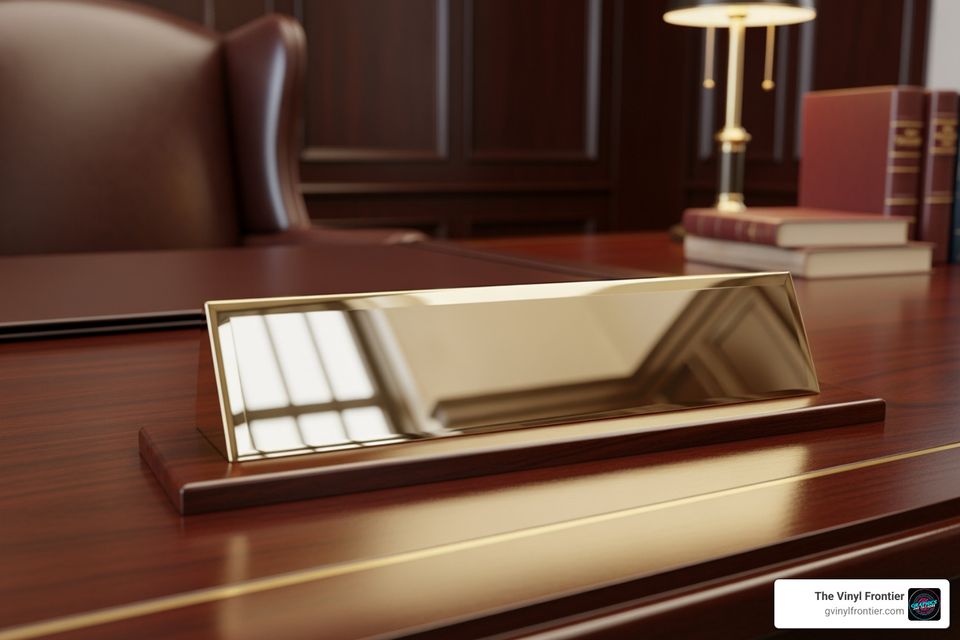
A brass name plaque makes an instant statement — professional, polished, and built to last. Whether it's on your office door, your desk, or a memorial bench, brass signals quality in a way that plastic or basic metal simply can't match.
Quick answer: What is a brass name plaque?
FeatureDetailsMaterialSolid brass (260 brass alloy is common)
Common sizes1.5" x 3" up to 12" x 24"
Thickness optionsLight (0.020") or heavy gauge (0.050")
FinishesPolished, satin, antique/patina
Engraving stylesDiamond-engraved, laser fused, oxidized lettering
Use casesOffice doors, desks, memorials, awards, gifts
Indoor/outdoorBoth — outdoor use requires a UV clear coat
Price rangeStarts around $7.50 for basic plates; $36+ for custom office plaques
Brass has been used for signage and nameplates for centuries — and for good reason. It's heavy, it looks expensive, and it ages beautifully. Over time, engraved letters darken naturally, giving the plaque an antique character that other materials never develop.
At The Vinyl Frontier, we help businesses and individuals make a strong visual impression through high-quality custom signage — including custom metal plaques and engraved brass name plaques that reflect your brand with lasting professionalism. Let's walk you through everything you need to know to choose the right one.
Why Choose a Solid Brass Name Plaque?
If you are comparing materials, the biggest difference is simple: solid brass feels like the real thing because it is the real thing.Plastic plates are lightweight, budget-friendly, and practical, but they do not deliver the same premium feel. Stainless steel is durable and modern-looking, but it has a cooler, more industrial appearance. Brass sits in the sweet spot for buyers who want warmth, tradition, and a high-end finish.
Here is a simple side-by-side comparison:
MaterialLookWeight/FeelDurabilityBest ForTrade-OffsSolid brassWarm, classic, upscaleHeavy, premiumVery good, especially with coatingOffices, memorials, awards, high-end brandingCan tarnish if left uncoated outdoors
PlasticBasic, functionalVery lightGood indoorsBudget labels, temporary useLess prestigious appearance
Stainless steelSleek, modernSolid but cooler in toneExcellentContemporary offices, industrial settingsLess traditional than brass
Some suppliers also separate brass by thickness categories, often described as a lighter sleek option and a heavier premium option. In practical terms, that means you can choose a thinner plate for desks or framed items, or a thicker, weightier plate when you want a more substantial architectural look.
That premium feel matters more than people think. A desk plaque, office door marker, or memorial nameplate is a small detail, but small details are often what make a space feel finished. Brass is one of those materials that says, "Yes, someone thought this through."
For a broader look at engraved metal options, our guide on custom bronze and engraved metal plaques is a helpful next read.
Selecting the Perfect Font and Logo for Your Brass Name Plaque
Customization is where a brass name plaque really shines. Most custom plaques can be personalized with:- Names
- Titles
- Room numbers
- Dates
- Dedications
- Logos
- House numbers
- Short messages or taglines
Font choice matters a lot. Serif fonts often look the most traditional and readable on brass. Sans serif fonts can work well for a cleaner, modern office style. Script fonts can look elegant, but they are not always ideal for small plates or all-cap text. Some script and outline fonts simply do not engrave as clearly, especially on smaller plaques.
A few practical rules help:
- Choose readability first, style second
- Keep text density reasonable on small plates
- Avoid overly thin or decorative fonts for important names or titles
- Use vector artwork for logos whenever possible
On many engraved brass plates, a logo can be etched and then darkened through oxidation for stronger contrast. That is especially useful if your design includes fine lines or detailed marks.
If you are not sure how much text fits comfortably, a good rule from product specs in the market is that larger plates often look best when you stay under about 8 letters per inch of width, even if the technical maximum is higher. In plain English: give the letters room to breathe.
If you want more design guidance, our article Blank Canvas, Endless Possibilities: Your Engraving Plate Primer breaks down layout and engraving basics in simple terms.
Finishes and Textures for Your Brass Name Plaque
Finish changes the personality of brass more than most people expect.The most common options include:
- Satin brass
- Polished brass
- Antique brass
- Patina-style finishes
- Oxidized engraved lettering
- Paint-filled engraving
- Sublimated or printed finishes for certain specialty applications
Satin brass is one of the most popular choices because it looks refined without being flashy. It hides fingerprints better than polished brass and works beautifully for offices, donor plaques, and wall signs.
Polished brass has the brightest, most reflective surface. It gives you that classic executive-desk look. If you want "corner office energy," this is the one.
Antique or patina finishes soften the shine and create an older, more established appearance. These are excellent for memorials, heritage settings, and spaces where you want brass to feel distinguished rather than glossy.
For lettering, you will commonly see:
- Diamond engraving for crisp, cut-metal detail
- Oxidized engraving for darkened letters
- Paint-filled engraving for stronger visibility
- Laser fused black graphics on some interior plates
- UV color printing on select products where logos need full color
One note on UV color printing: it can look great, especially for logos, but some product sources indicate that color-printed metal surfaces may have a shorter lifespan than traditional engraved-and-filled methods, with around two years of color durability in some use cases. For maximum longevity, classic engraved lettering usually wins.
If you want to explore finish choices in more depth, see our guide Shine On: How to Choose and Design Your Perfect Engraved Metal Sign.
Durability and Maintenance: Indoor vs. Outdoor Use
Brass is durable, but indoor and outdoor use are not the same thing.Indoors, a solid brass plaque can stay attractive for years with very little maintenance. On a desk, office door, display case, or award base, brass generally performs beautifully with minimal fuss.
Outdoors, brass is still a strong option, but it needs protection. The biggest issue is not rust, because brass does not rust like steel. The issue is tarnish, oxidation, and weather exposure. Sun, rain, humidity, and airborne contaminants can all change the surface over time.
That is why a UV clear coat is commonly recommended for outdoor brass plaques. The coating helps protect the finish, slows tarnishing, and extends the life of the engraved surface. Research from brass plaque sellers consistently points to clear coating as one of the best practices for outdoor use.
Outdoor brass is commonly used for:
- Memorial benches
- Stone markers
- Tree dedications
- Garden plaques
- Building identification
- Donor recognition markers
Some brass products are specifically labeled for indoor use only, especially thinner satin brass plates such as 0.020 inch and heavier ornamental indoor plaques like 0.050 inch versions sold for furniture, frames, and interior doors. So before ordering, always confirm whether the plaque is intended for interior or exterior installation.
260 brass is a common alloy for nameplates and office plaques. It is known for good formability and an attractive finish, which helps explain why it appears frequently in custom plaque products.
Another thing to know: brass naturally develops character over time. Engraved letters often darken as they oxidize, which many buyers actually like. For memorials and traditional settings, that aged look can be part of the appeal rather than a defect.
For more on engraved sign materials and use cases, visit our A-Z Guide to Engraved Signs.
Maintaining the Luster of Your Brass Name Plaque
If you want your plaque to stay bright and polished, maintenance matters.For indoor plaques:
- Dust regularly with a soft cloth
- Avoid abrasive cleaners
- Wipe fingerprints off polished finishes
- Keep moisture exposure low
For outdoor plaques:
- Inspect the clear coat periodically
- Clean gently when dirt builds up
- Reapply a clear protective coating when needed
- Use the right mounting hardware so water does not sit behind the plaque
Some product guidance in the market recommends using fine steel wool to clean weathered outdoor brass before recoating it with a clear spray lacquer or clear spray paint. That can help restore the surface when the original protective layer has worn down. If the plaque is especially valuable or historic, professional restoration is the safer route.
A few smart maintenance habits:
- Do not use harsh acidic cleaners
- Test any cleaner on a small area first
- Recoat outdoor plaques before heavy weathering sets in
- If you like the antique look, let the brass age naturally and just protect the structure
In other words, brass can be high class without being high drama.
Sizing, Thickness, and Installation Best Practices
Brass name plaques come in a surprisingly wide range of sizes. Common market offerings run from tiny 1.5 inch by 3 inch tags up to 12 inch by 24 inch plaques, with many custom dimensions in between.Small sizes are often used for:
- Desk name bars
- Framed art labels
- Award bases
- Keepsake boxes
- Memorial flag cases
Medium sizes work well for:
- Office doors
- Wall identification
- Reception signage
- Directional markers
Larger sizes are often used for:
- Dedication plaques
- Donor walls
- Building signage
- Outdoor memorial displays
Thickness is just as important as size. Two very common brass thicknesses mentioned across product research are:
- 0.020 inch for lighter plaques
- 0.050 inch for heavier, more substantial plaques
A 0.020 inch plate is often enough for indoor nameplates, desk plaques, and framed applications. A 0.050 inch plate has a more robust feel and can look more premium, though many heavy-gauge decorative brass products are still intended for indoor use unless specifically coated and rated for outdoor exposure.
When choosing size and thickness, think about:
- Viewing distance
- Amount of text
- Surface type
- Indoor or outdoor use
- Desired visual weight
- Whether the plaque is decorative, informational, or commemorative
If you are adding several lines of text, do not choose a plate that is too small just to save space or budget. Tiny text on a beautiful brass plaque is still tiny text. Brass cannot perform miracles, although it does try.
We also recommend matching the installation method to the plaque's size and location. That helps prevent curling, loosening, or uneven mounting later on. For related ideas on durable metal branding, see Forging Your Brand with Custom Metal Signs in Alabama.
Mounting Methods for Every Surface
The best installation method depends on where the plaque is going.Common mounting options include:
- Adhesive backing
- Screw holes with matching screws
- Wall brackets
- Magnetic tape
- Stud mounts
- Decorative backing for display pieces
Here is when each works best:
Adhesive backing
Best for smooth indoor surfaces such as:
- Desk fronts
- Office doors
- Cubicles
- Frames
- Display boxes
Double-sided tape is convenient, but most product research treats it as indoor only. Heat, moisture, and rough outdoor conditions can weaken adhesive over time.
Screw holes
Best for:
- Wood
- Stone
- Exterior walls
- Benches
- Long-term installations
For outdoor use, screw mounting is usually the safer choice. It gives a more secure hold and stands up better to weather. Pre-drilled holes also make alignment easier.
Wall brackets
Best for:
- Professional office plates
- Door signs
- Interior corridors
Bracket-mounted metal office plaques are popular because they give the finished sign a polished, architectural look. Some office plaque products include tape by default and offer brackets as an upgrade.
Magnetic tape
Best for:
- Temporary office uses
- Changeable spaces
- Metal surfaces
This is helpful when names or departments may change.
Stud mounts
Best for:
- Premium wall installations
- Stone or masonry surfaces
- Larger custom plaques
Stud mounting creates a clean, professional look and can float the plaque slightly off the wall.
Velvet or decorative backing
Best for:
- Award presentations
- Gift items
- Keepsake displays
These are less about structural mounting and more about presentation.
Installation best practices: Measure twice before drilling or sticking. Clean the mounting surface thoroughly. Use a level for anything visible at eye height. Choose hardware rated for the plaque weight. For outdoor brass, prioritize mechanical fastening over adhesive. If mounting on stone or masonry, use anchors designed for that material.
Frequently Asked Questions about Brass Name Plaques
How long does it take to produce a custom brass plaque in 2026?
In 2026, a typical custom brass plaque order often falls within a 2 to 8 business day production window, depending on complexity.Based on current market research:
- Simple standard plate orders can ship in about 2 to 3 business days
- Custom-cut plaques may take around 5 to 8 business days
- Some office plaque products ship about 2 business days after proof approval
- Standard shipping may add roughly 3 to 8 business days depending on service level
What affects turnaround time:
- Whether a proof needs approval
- Custom sizing or shape cutting
- Logo setup and artwork prep
- Quantity ordered
- Choice of finish
- Mounting hardware requirements
As a rule, if your plaque includes custom artwork, multiple lines, or special mounting, allow extra time. Proof approval is often the main checkpoint. The faster you approve, the faster production can begin.
What factors influence the cost of a custom nameplate?
Pricing varies quite a bit because custom plaques are built around your choices. Research shows entry-level brass plates can start around $7.50, while office-style custom nameplates often begin around $36, and larger premium custom engraved brass plates can start much higher.The biggest pricing factors are:
- Overall dimensions
- Material thickness
- Solid brass versus lighter alternatives
- Number of engraved lines
- Font and layout complexity
- Logo setup
- Finish selection
- Mounting method
- Quantity ordered
A few examples from market data:
- Some sellers charge per engraved line, with early lines costing more than additional ones
- Logo uploads may carry a one-time setup fee, often around $15
- Volume discounts are common for orders of 5, 10, 50, or more
- Heavier gauge brass generally costs more than thin stock
- Custom shapes and edge details increase price
If you are budgeting, ask for an itemized quote. That way you can compare the cost of size, engraving, finish, and mounting separately instead of guessing where the price changed.
Can I use a brass nameplate for outdoor memorials?
Yes, you can, and brass is actually a very fitting material for outdoor memorial applications when it is properly specified.It is commonly used for:
- Memorial benches
- Tree dedications
- Stone markers
- Garden remembrance plaques
- Donor recognition installations
For outdoor memorial use, the must-haves are:
- A plaque rated for exterior use
- UV clear coat or another protective finish
- Secure mounting, usually screws or studs
- Enough thickness and rigidity for the environment
- Realistic expectations about aging
Outdoor brass will change over time. That is normal. The engraved areas may darken, and the face may develop patina if left exposed. Some families and organizations love that aged, dignified look. Others prefer to clean and recoat periodically to keep the brass brighter.
If the plaque will be mounted to stone, bench slats, or masonry, mechanical fasteners are usually the right choice. Adhesive alone is rarely the best long-term outdoor plan.
Conclusion
A brass name plaque is one of those rare products that is both practical and elegant. It labels a door, identifies a desk, honors a person, or marks a space, but it also adds character in the process.The right plaque comes down to a few key choices:
- Solid brass for premium feel
- The right size and thickness for readability
- A finish that matches your setting
- An engraving method that fits your design
- Outdoor coating and secure mounting when needed