Protect Your Paint with the Best Vehicle Coatings
Why Car Coatings Protective Choices Matter for Your Vehicle's Finish
Car coatings protective systems are one of the most effective ways to defend your vehicle's paint from daily wear, UV damage, and environmental contaminants. Here's a quick breakdown of your main options:
Protection TypeDurabilityBest ForCarnauba WaxUp to 6 monthsBudget-friendly shine
Synthetic Sealant1-2 yearsDaily drivers
Ceramic Coating2-5+ yearsLong-term chemical and UV defense
Graphene Coating8+ yearsMaximum hardness and hydrophobics
Paint Protection Film (PPF)5-10 yearsPhysical chip and scratch protection
Your car's paint isn't just cosmetic. Underneath the color sits a clear coat — a transparent layer that takes the brunt of UV rays, bird droppings, acid rain, and road grime every single day. Once that clear coat is gone, the damage goes straight to the paint itself, and fixing it means a trip to a body shop.
The right protective coating puts a barrier between your finish and the outside world. Some bond chemically to the clear coat. Others sit on top as a sacrificial layer. The best choice depends on your budget, driving habits, and what surface you're protecting — standard paint, a vinyl wrap, or PPF.
At The Vinyl Frontier, we work with vehicle wraps and custom graphics every day, which means we understand how critical proper surface protection is for keeping vehicles looking sharp and professional — whether you're driving a branded business vehicle or a personal car you're proud of.
Comparing Types of Car Coatings Protective Systems
Understanding how different automotive coatings operate is the first step toward keeping your vehicle in showroom condition. While every product promises gloss and defense, the underlying chemistry and physical characteristics vary dramatically. To get a comprehensive overview of preserving clearcoat beauty over time, check out our guide on Beyond The Wash Ultimate Guide To Automotive Paint Protection.Traditional Wax and Synthetic Sealants
Traditional carnauba wax has been the standard for automotive shine for decades. Harvested from Brazilian palm leaves, natural carnauba wax provides a rich, warm glow that detailers love. However, wax merely sits on top of your clear coat as a soft, temporary layer. Because it melts at relatively low temperatures and breaks down quickly under harsh soap or heat, natural waxes usually last anywhere from a few weeks up to 6 months.Synthetic paint sealants were developed to bridge the gap between traditional wax and modern liquid coatings. Formulated from engineered polymers, synthetic sealants cross-link across the paint to form a tighter bond than natural wax. They deliver improved heat tolerance, better resistance against detergents, and a lifespan ranging from 6 months up to 2 years. While sealants offer a sharper, more reflective shine than warm carnauba, they still lack the permanent molecular chemical bond provided by advanced ceramic formulations.
Nano-Ceramic and Graphene Formulations
Nano-ceramic coatings represent a massive leap forward in paint protection technology. Rather than sitting loosely on the clear coat, liquid ceramic coatings utilize silicon dioxide (SiO2) or silicon carbide (SiC) nano-particles that chemically bond directly to your vehicle's factory clear coat or wrap surface.This creates a semi-permanent, glass-like microscopic shell that does not wash off during routine cleaning. Quality consumer or entry-level ceramic products, such as Feynlab Ceramic Coating - Professional Grade Protection, offer exceptional gloss and hydrophobic properties for 1 to 2 years, while multi-layer professional coatings can easily last 2 to 5 years or longer.
Graphene coatings are the newest evolution in liquid surface defense. By infusing ceramic liquid polymers with graphene—a single layer of carbon atoms arranged in a honeycomb lattice—manufacturers have enhanced thermal conductivity and tensile strength. Advanced products like Alpha Hybrid Graphene 10H feature certified 10H pencil hardness ratings and impressive durability lasting over 8 years. Additionally, graphene-infused formulas like Gen-3 Evolution - Ceramic coating with Graphene deliver over 30% more gloss than standard rivals and up to 75% better paint gloss retention in freezing temperatures down to -10°C.
Selecting Car Coatings Protective for Vinyl Wraps and PPF
Vehicle wraps and Paint Protection Film (PPF) require specialized care. Traditional rigid ceramic coatings designed for solid painted clear coats can sometimes crack, cloud, or alter the texture of flexible vinyl films or self-healing TPU clear bras.To safely protect wrapped or filmed vehicles without damaging the underlying material, specialized flexible nano-coatings are required. Products like Ecocoat Shield - IGL Coatings utilize an elastic cyclosilazane matrix specifically designed for flexible thermoplastics, PVC, and TPU.
This allows the coating to flex alongside the film without cracking while providing chemical resistance against pH levels ranging from 1 to 13 and offering up to 24 months of UV defense. If you want to dive deeper into film preservation, read The Ultimate Guide To Paint Protection Film.
Key Benefits of Automotive Paint Coatings
Investing in a dedicated automotive coating transforms how you care for your vehicle while safeguarding its long-term market value.Protection FactorCarnauba WaxSynthetic SealantsCeramic / Graphene CoatingsPaint Protection Film (PPF)UV DefenseLowModerateExceptionalExceptional
Chemical ResistanceWeak (pH 6-8)Moderate (pH 4-10)Extreme (pH 1-13)High (pH 2-12)
Hydrophobic EffectModerate (80°-90°)Good (90°-100°)Extreme (105°-115°)High (95°-105°)
Physical Rock Chip ResistanceNoneNoneMinimal (Micro-swirls)Superior (Impact absorbing)
Average Lifespan1 to 6 months6 to 24 months2 to 8+ years5 to 10 years
Environmental Shielding and Hydrophobic Action
Every day your vehicle sits outside, solar UV rays work to break down clear coat molecules, leading to premature oxidation, dullness, and eventual clear coat failure. On top of solar damage, biological contaminants such as bird droppings, tree sap, and smashed insects contain acidic compounds that can permanently etch raw clear coats in a matter of hours.Modern car coatings protective products create an impermeable chemical shield that neutralizes acid exposure and blocks radiation.
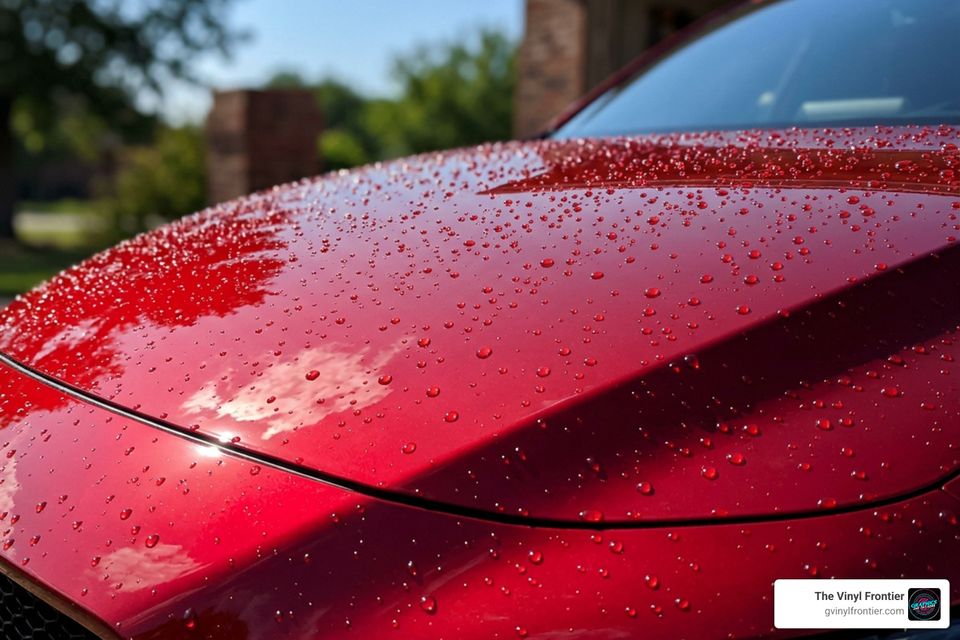
Furthermore, these coatings dramatically lower surface tension, creating extreme hydrophobicity. High-end coatings like Feynlab® Ultra V3 - FEYNLAB® produce a water contact angle of 113 degrees. This hydrophobic "lotus effect" forces water to bead into tight spheres that roll right off, picking up loose surface dust and grime as they slide away. For additional strategies on battling harsh elements, review our guide on How To Save Your Car Paint From Birds And Bad Weather.
Base Coatings Versus Top Coats
In professional detailing, achieving maximum durability and water performance often involves a multi-layer strategy combining a hard base coating with an ultra-slick top coat.- Base Ceramic Coatings: Typically high-solids formulations designed to form a thick, hard molecular bond with the clear coat. Their main job is structural defense, chemical holdout, and scratch mitigation.
- Top Coats: Softer, hyper-hydrophobic flexible layers applied over the cured base coat. Specialized top layers, such as EXOv4 Ultra Durable Hydrophobic Coating Hydrophobic coating V2.gtechniq.com, offer 18 to 24 months of extreme water-repellency, slickness, and micro-marring resistance.
By pairing a tough base layer with a self-cleaning top coat, water spots are significantly easier to wipe away before mineral deposits burn into the finish.
Graphene Integration and Scratch Realities
A common misconception among car owners is that applying a ceramic or graphene coating turns vehicle paint into an indestructible, bulletproof shield. While high-grade coatings boasting 10H pencil hardness reduce micro-marring from soft wash mitts or light towel wipes, no liquid coating can prevent heavy scratches, rock chips, or key gouges.Graphene integration improves coating performance by reducing water spot etching (thanks to lower heat absorption) and improving surface slickness, but clearcoat physical limits remain. If absolute defense against stone chips and physical scratches on high-impact areas is your priority, combining Paint Protection Film with a ceramic top-coat is the ultimate solution.
Surface Preparation and Application Step-by-Step
A protective coating is only as good as the surface preparation beneath it. Applying an advanced coating over contaminated or swirled paint traps imperfections underneath for years.Essential Pre-Coating Prep Steps
Preparing your vehicle requires systematic decontamination and paint correction:Two-Bucket Wash: Clean the entire exterior using a dedicated strip soap to dissolve old waxes and road film without leaving gloss-enhancing oils behind.
Chemical Decontamination: Apply an iron remover spray to dissolve embedded brake dust and fallout particles pinned in the clear coat.
Claying Process: Glide a clay bar or synthetic clay pad with dedicated lubricant across all panels to remove trapped gritty debris, leaving the finish smooth.
Paint Correction: Use a dual-action polisher paired with compound or polishing pads to remove swirl marks, light scratches, and oxidation.
Panel Prep Wipe: Thoroughly wipe down all polished panels with an isopropyl alcohol (IPA) panel wipe to clean away polishing oils, guaranteeing raw clearcoat contact for optimal chemical bonding.
Application Process and Common Pitfalls
Once prep work is complete, applying a ceramic coating requires control and patience:Priming the Applicator: Wrap a suede microfiber cloth around an applicator block and drop 10 to 15 drops of coating onto the pad.
Cross-Hatch Pattern: Work in small sections (roughly 2x2 feet), applying the liquid in straight, overlapping horizontal and vertical lines.
Monitoring Flash Time: Watch for the coating to "flash" or sweat—a rainbow-like appearance that occurs within 1 to 3 minutes depending on ambient humidity and temperature.
Leveling and Buffing: Using a clean, short-pile microfiber towel, gently level the high spots. Follow immediately with a second plush microfiber towel to buff the surface to a streak-free shine.
Cure Window: Keep the vehicle in a dry, indoor environment for at least 12 to 24 hours post-application. Avoid chemical washes or soap for at least 7 days while the coating completes its final cure.
Common Mistakes to Avoid:
- Working in direct sunlight or on hot panels, which causes the coating to flash instantly and leave hardened dark streaks (high spots).
- Waiting too long before buffing, requiring abrasive compound polishing to correct mistake areas.
- Exposing the freshly coated vehicle to rain or water before the initial dry cure window closes.
DIY Products Versus Professional Installation Costs
Choosing between a DIY installation and hiring professional detailers comes down to skill level, available equipment, and your target budget.You can learn more about managing vehicle finish care in our article Guard Your Gloss The Ultimate Guide To Car Color Protection.
- DIY Coating Products: High-quality DIY coating kits (such as CQUARTZ UK 3.0 or consumer spray coatings) range from $30 to $130 for bottle kits. Spray-on ceramic sealants like Shine Armor Fortify Quick Coat offer rapid 15-minute cure times for around $23. DIY options save on labor, but require you to invest hours into cleaning, claying, and polishing.
- Professional Installation: Professional ceramic installation ranges from $600 to upwards of $2,000 depending on vehicle size and the amount of paint correction required prior to application. Professional services include commercial-grade coatings with 5-to-10-year warranties (often registered directly on CarFax reports) installed in climate-controlled, dust-free environments.
Choosing and Maintaining Your Vehicle Coating
To ensure your investment lasts as long as advertised, routine care and climate considerations are essential.Maintaining Your Car Coatings Protective Finish
While ceramic coatings feature impressive self-cleaning qualities, they are not maintenance-free. Follow these basic practices to keep your protective surface hydrophobic and clear:- Wash Every 2 Weeks: Wash your car regularly using a pH-neutral car shampoo free from added waxes or gloss enhancers.
- Use the Two-Bucket Method: Dedicate one bucket to clean soapy water and a second equipped with a grit guard for rinsing dirt out of your microfiber wash mitt.
- Never Use Automated Brush Washes: Abrasive nylon brushes at automated drive-through washes physically scratch ceramic top coats and destroy hydrophobic performance.
- Dry Safely: Use a soft, plush drying towel or a filtered leaf blower/car dryer to air-dry the finish without creating friction marks.
- Apply Periodic Maintenance Sprays: Every 3 to 6 months, apply a ceramic booster spray or quick detailer after washing to rejuvenate hydrophobic slickness.
Matching Coatings to Driving Habits, Climate, and Budget
Select your protective strategy based on where and how you drive:- Daily Drivers in Cold Climates: Vehicles exposed to harsh winter conditions, road salt, and sub-zero temperatures benefit immensely from chemical-resistant graphene ceramic coatings that stay slick even in freezing weather.
- Highway Commuters: Drivers covering high interstate mileage daily face gravel and rock chips; combining front-end Paint Protection Film with a ceramic top-coat offers ideal protection. To review full clear bra coverage strategies, read The Ultimate Clear Bra Installation Guide Protect Your Assets.
- Garaged Weekend Vehicles: A quality 2-year ceramic coating or synthetic polymer sealant provides superb gloss and dust resistance without requiring heavy financial investment.
Frequently Asked Questions About Car Paint Protection
Will a ceramic coating make my car completely scratch-proof?
No, ceramic coatings do not make vehicles completely scratch-proof.While 9H and 10H ceramic formulations provide resistance against minor micro-marring, wash swirls, and fine towel marks, they cannot stop heavy scratches, key marks, or road debris impacts. For true physical chip protection, Paint Protection Film (PPF) is required.
How long do different types of paint protection last?
Longevity varies by product category and maintenance:- Carnauba wax: 1 to 6 months
- Synthetic sealants: 6 to 24 months
- Entry-level DIY ceramic coatings: 1 to 2 years
- Professional multi-layer ceramic/graphene coatings: 3 to 8+ years
- Paint Protection Film: 5 to 10 years