
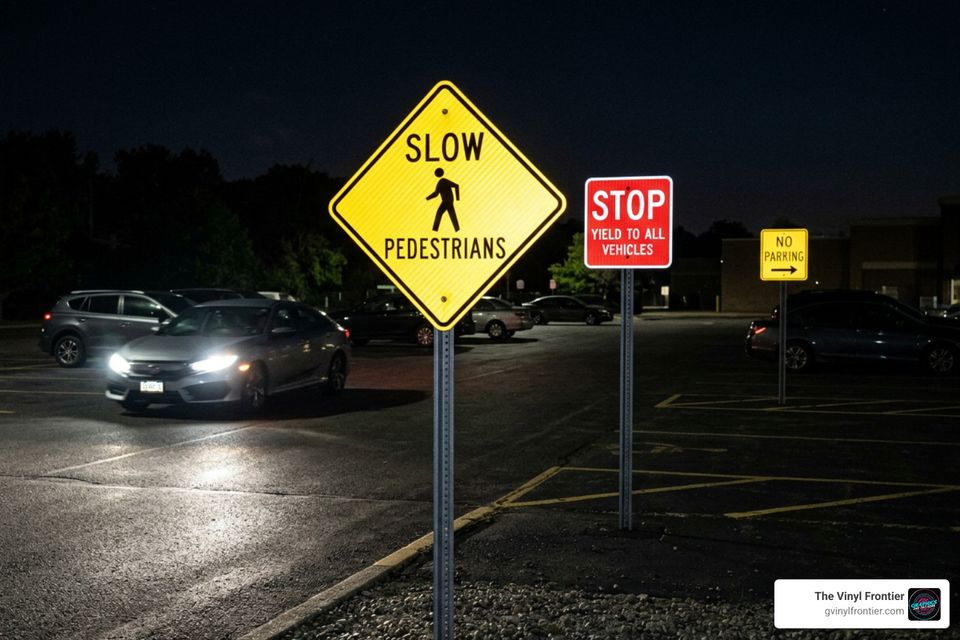
Glowing Places: Why Your Business Needs Reflective Safety Signs
Why Reflective Safety Signs Matter for Your Business in 2026
Reflective safety signs are signs made with special sheeting that bounces light — usually from vehicle headlights — directly back toward the viewer. This makes them visible in the dark without any power source.
Here's a quick summary of what you need to know:
- What they are: Signs coated with retroreflective sheeting that returns light to its source
- How they work: Tiny glass beads or microprismatic lenses redirect headlight beams back to the driver's eyes
- Main grades: Engineer Grade (basic), High-Intensity Prismatic (mid-range), and Diamond Grade (maximum brightness)
- Key uses: Road signs, parking lots, workplace hazard warnings, fire exits, property boundaries
- Why they matter: Nearly 50% of traffic deaths happen at night, despite only 25% of driving occurring after dark
- Regulations: Governed by MUTCD, OSHA, and ISO standards depending on location and use case
Roads don't shut down after dark — and neither does the risk of accidents. A poorly lit parking lot, an unmarked hazard, or a faded exit sign can expose your business to real danger and real liability. In 2026, visibility standards are tighter than ever, and businesses that ignore signage quality are taking a costly gamble.
The good news? The right reflective sign can increase nighttime visibility by up to 1,000 times compared to a standard non-reflective sign. That's not a small upgrade — that's the difference between a driver seeing your warning with enough time to stop, or not seeing it at all.
At The Vinyl Frontier, we specialize in custom signs, vehicle wraps, and high-quality graphics — including reflective safety signs built to perform in any environment. In the sections below, we'll walk you through everything you need to know to choose, install, and maintain the right reflective signage for your business.
The Science of Visibility: How Reflective Safety Signs Work
To understand why these signs are so effective, we have to look at the science of light. Traditional surfaces scatter light in all directions, which is why a standard painted sign looks dull and hard to read at night. Mirrors reflect light away at an equal and opposite angle (specular reflection), which only helps you if you are standing at the exact correct angle.Reflective safety signs rely on a process called retroreflection.
Retroreflective surfaces are engineered to redirect light straight back to its original source, regardless of the angle at which it hits the sign. When a driver's headlights strike a retroreflective sign, the light bounces directly back into the driver's eyes rather than scattering into the night sky. This creates a brilliant, glowing effect that requires zero electrical power.
There are two primary technologies used to achieve retroreflection:
Glass Bead Technology: This traditional method uses millions of microscopic glass beads embedded in a flexible vinyl backing. The beads act like tiny lenses, bending and focusing the incoming light before bouncing it back out.
Microprismatic Technology: This modern approach uses microscopic, three-sided prisms sealed inside a durable plastic film. Microprismatic signs return significantly more light than glass beads, offering superior brightness and wide-angle visibility.
For a deeper dive into how different signs communicate critical information, check out our Detailed Guide to Safety Signs or explore the engineering behind these materials directly through 3M Reflective Sheeting Solutions.
Materials and Reflective Sheeting Technologies
Not all reflective safety signs are created equal. The American Society for Testing and Materials (ASTM) classifies reflective sheeting into different grades based on their retroreflective performance and durability under the ASTM D4956 standard.When choosing a sign, matching the right grade of sheeting to your specific environment is crucial. Most outdoor safety signs use heavy-duty, rust-free aluminum as a backing material to ensure weather resistance, handling temperature swings from -10°F to 130°F.
Here is a quick look at how the three main sheeting grades compare:
Sheeting GradeTechnology TypeAverage LifespanTypical Visibility RangeBest ForEngineer Grade (Type I)Glass Beads7 YearsUp to 500 FeetParking lots, low-speed driveways, non-critical property signs
High-Intensity Prismatic (Type IV)Microprismatic Lenses10 YearsUp to 1,000 FeetPublic roads, construction zones, high-risk industrial areas
Diamond Grade (Type IX)Advanced Microprisms12+ YearsOver 1,000 FeetHigh-speed highways, complex intersections, emergency exits
To explore raw materials and bulk roll options, you can review the 3M™ Reflective Sheetings & Sign Materials - Lyle Signs catalog.
Engineer Grade Reflective Safety Signs
Engineer Grade (EG) sheeting represents the entry-level standard for retroreflection. It utilizes embedded glass beads to provide reliable visibility in low-light conditions. While it is the least bright of the three main options, it is highly cost-effective and perfectly suited for off-road applications, private properties, and slow-speed warehouse environments.For projects requiring flexibility and clean application, materials like 3M Flexible Engineer Grade Sheeting offer a reliable 7-year outdoor lifespan and excellent durability.
High-Intensity Prismatic (HIP) Reflective Safety Signs
High-Intensity Prismatic (HIP) sheeting is a mid-range, high-performance option that uses microprismatic lenses. It is three to four times brighter than Engineer Grade sheeting and is the minimum standard required by many state Departments of Transportation (DOTs) for public road signs. With a 10-year warranty, HIP signs are highly resistant to UV fading and harsh weather, making them the ideal choice for business entrances, busy parking lots, and industrial hazard zones.Diamond Grade (DG3) Sheeting
Diamond Grade is the gold standard of retroreflective technology. It returns up to 10 times more light than traditional glass-beaded sheeting, making it visible from extreme distances and wide angles. This grade is typically reserved for high-speed roads, complex intersections with heavy visual clutter, and critical emergency escape routes. If your business is located off a fast-moving highway where drivers need maximum warning time, Diamond Grade is the safest investment.Key Applications and Types of Reflective Signage
From protecting your physical property to keeping workers safe in a busy warehouse, reflective safety signs serve a massive variety of functions.Whether you need pre-made regulatory signs or highly personalized custom branding, picking the right application ensures you stay compliant and visible. For a straightforward look at ordering signs for your business, check out A Simple Guide to Buying Safety Signs Online.
Road and Traffic Management
If your business has a private driveway, a parking garage, or loading docks, you must manage traffic flow safely. Using signs that meet Official MUTCD Traffic Sign Guidelines ensures that drivers instantly recognize standard symbols like Stop, Yield, and Speed Limit.If you are looking for compliant traffic control options, resources like Rice Signs: MUTCD Traffic Signs, Roll-Up Signs and MASH ... offer standard layouts, while you can also order personalized, rugged options via Custom Traffic Reflective Aluminum Signs to match your property's layout.
Workplace and Industrial Safety
In busy industrial spaces, warehouses, and construction zones, hazards don't vanish when the lights go down. OSHA-compliant reflective signs are essential for marking high-risk areas, forklift pathways, and chemical storage zones. Using highly visible warning signs and reflective hazard strips helps prevent costly workplace accidents and ensures your business complies with federal safety laws. For a look at standard safety sign templates, you can browse OSHA and Safety Signs | Signarama Mobile, AL as an external reference.Property Protection and No Trespassing
Keeping unauthorized visitors off your property is a 24-hour job. Standard printed signs are useless after dark, allowing trespassers to claim they "didn't see" your warnings. A heavy-duty, reflective "No Trespassing" or "Private Property" sign catches headlights instantly, making boundaries unmistakably clear. Learn more about protecting your perimeter in our guide, Property Patrol: No Trespassing Signs.Standards, Regulations, and Compliance for Reflective Signs
Operating a business means keeping up with a web of local, state, and federal regulations. For signage, the main governing bodies in the United States are the Federal Highway Administration (which maintains the MUTCD) and the Occupational Safety and Health Administration (OSHA).Failing to maintain minimum retroreflectivity standards can result in hefty fines and, worse, leave your business liable in the event of a nighttime accident. If a driver hits an unmarked hazard on your commercial property because your signs were faded or non-reflective, a court may rule that you failed to provide a reasonable duty of care.
Fire Safety and Emergency Exit Requirements
In emergency situations, power outages often plunge buildings into total darkness. While standard reflective signs work beautifully when hit by a flashlight beam, advanced safety signs combine reflective materials with photoluminescent (glow-in-the-dark) technologies. These dual-action signs absorb ambient light during the day and glow brightly for hours during a power failure, ensuring that emergency escape routes remain visible under all conditions.To learn more about marking your building's safety equipment correctly, read our CO2 Fire Extinguisher Signs Guide.
Best Practices for Installing and Maintaining Your Signs
Buying high-quality reflective safety signs is only half the battle; they must be installed and maintained correctly to do their job.Follow these best practices to maximize the lifespan and effectiveness of your signs:
- Height and Angle: For parking lots and driveways, mount signs at a height of 5 to 7 feet from the ground to ensure they align perfectly with vehicle headlight beams. Tilt the sign slightly away from the road (about 3 degrees) to prevent blinding glare from bouncing directly back into a driver's eyes.
- Clear Obstructions: Perform seasonal checks to ensure that tree branches, bushes, and utility poles do not block the line of sight for approaching drivers.
- Gentle Cleaning: Over time, road grime, pollen, and dust will coat the reflective surface, drastically reducing its retroreflectivity. Clean your signs at least once a year using a soft cloth, warm water, and a mild, non-abrasive soap. Avoid harsh chemicals or abrasive scrubbers, which can scratch the delicate microprismatic layer.
- Routine Audits: Walk or drive through your property at night at least once a year. Take note of any signs that look dim, cracked, or difficult to read, and schedule them for immediate replacement.